


You can make a difference!
As climate change and conservation become increasingly growing concerns, sustainability efforts - both private and public - are expanding at a phenomenal rate. This recent increase in conservation efforts not only benefits the environment but also opens up a whole new range of career paths that offer opportunities to build your career while making a positive impact on the environment.
Whether you’re studying engineering, business, arts, economics, or any other field, important roles are emerging in this new industry that are open to everyone.
What can we do?
The emergence of green technology, sustainability movements, and cleaner initiatives has not only allowed us to combat climate change but also opened up a whole new avenue of careers that previously never existed. Moreover, people can contribute to sustainable development whether they are in a science field or any other professional sector.
The chart below shows us how the recent decade has evolved and increased the demand for labour in the environmental sector. Aside from the pandemic, Statistics Canada data indicate that employment in areas related to sustainability is growing healthily.
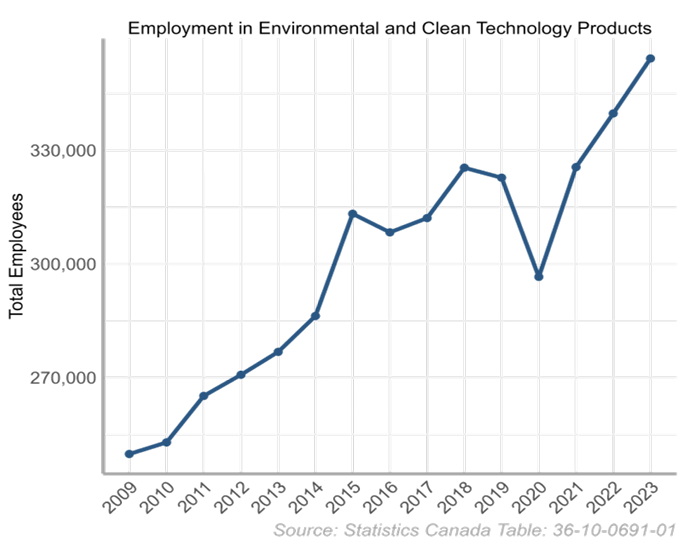
Statistics Canada. Table 36-10-0691-01 Employment in the environmental and clean technology products sector by demographic characteristic
Sustainability as a profession has most commonly been understood as offered only for science graduates and engineers. There is a common belief that sustainability-related careers are often limited to individuals with degrees in environmental, conservation, or agricultural studies only.
In reality, numerous sustainability-focused occupations work towards preserving the environment, yet don’t necessarily require a degree in science. Examples of these range from being an environmental data analyst, policy maker, environmental economist, fashion designer, environmental journalist, or marketing specialist. Every individual who has the passion and drive to help can actually do so in their own unique way and make a sustainable difference in their own professional field. Below, we’ll further expand on a few of the countless different sectors you can enter.
1. Environmental Reporter/Journalist
Living in a generation where people are mostly connected to the digital world and media stream comes as an opportunity to more effectively spread awareness about environmental conditions. In this profession, journalists gather and publish information such as data, interviews, and issues relating to the natural world.
They are the individuals who report the rising sustainability problems, such as ecological racism, waste management, sustainable fashion, environmental policies, and many others.

Photo by Mido Makasardi ©
There are several ways to get involved in being an advocate for sustaining the world. It is also important to know that there is no such thing as a “small effort” when it comes to addressing issues, and so every effort is appreciated.
a. Social Media
Social Media platforms have been an essential tool that spreads awareness about the current state of our environment. Just by sharing content that is beneficial for empowering nature, we are already one step closer to the betterment of preserving our surroundings.
b. Media Volunteering
Being a part of a team in school that covers reports about the environment is a crucial role in sharing knowledge on this matter. At the University of Alberta, the Sustain SU Team has several groups that cater to this demand, which helps students improve their writing skills at the same time, reporting events of this nature.
c. Being a Source
For a report to actually be started and made, having a resource is extremely important. It is where every topic starts to rise and turn into news articles or blogs. This is why it is vital to report any environment-related issues and concerns to the journalism team for it to be heard and shed light on. Even the slightest observation, such as air/water pollution and concerns about green spaces around your neighborhood, can lead to a vital report shared with the public. News starts with information like this, eventually shedding light on improving the surroundings of a certain place, which is highly beneficial.
2. ESG (Environmental Social Governance) Lawyer/Politics
Navigating the challenges around the environment, such as resource distribution and land use, is crucial to sustaining our surroundings. Moreover, issues such as risk of pollution and conflict of business demands and environmental conditions also play a huge part. Additionally, in an economy where businesses are on the rise, considering every company’s action on these demands has a vital connection to how they comply with regulations and risk while still maintaining their strategy and reputation.
These ESG lawyers play a major role in ensuring that corporations are complying with these laws, managing environmental disasters, and addressing potential risks.

Photo by Mikhail Nilov
It doesn’t require people to be lawyers to defend our environment. Even the simplest step can turn into extraordinary results that are beneficial not only for our surroundings but also for us. People can get involved by:
a. Attending Informational Events
To defend an issue and to plan an action, wisdom is a key tool that an individual must have. And so, being present at informational seminars relating to the environment is a huge step in gaining more knowledge on current and possible problems we are facing.
b. Joining Organizations/Clubs
Starting small and expanding big has been the ongoing motto in most aspects of life. That’s why even joining organizations is a step that is beneficial. At the University of Alberta, there is the Sustain SU program that has a wide array of groups you can join based on your interests. You are not just helping your university, but you are contributing to the world just by doing that.
c. Do your own research
A great way to be aware of certain environmental relations in the government or law-making is to conduct your own study on it. Individuals have the power to vote in elections, and so having that wisdom about several platforms of the running candidates allows better reasons for voting, and greater election results.
3. Sustainable Fashion
Similar to our three pillars of sustainability, sustainable fashion is fashion that’s mindful of its social, environmental, and economic factors. Sustainable fashion focuses on the use of eco-friendly materials, paying workers a living wage, and reducing waste.
The fashion industry has high environmental and social costs, primarily due to fast fashion. Fast fashion practices involve harmful emissions, dangerous chemicals, fashion waste, excessive water consumption, and the human cost. As these issues have started coming to light, more and more consumers want their garments to be sustainable, both environmentally and socially. So how can you get involved?

Photo by Pavel Danilyuk
a. Be a fashion designer
Multiple different brands are emerging, basing their manufacturing on sustainable fabrics, like Pinatex, Mylo, and Econyl. Major brands are also switching to more ethically produced garments, but they face many difficulties switching to newer, more sustainable designs. This is where you come in. Designing sustainable garments using sustainable fabrics like pineapple leather, mushroom leather, hemp, regenerated nylon, and countless others, you not only utilize this new industry but also significantly contribute to the transition to eco-friendly clothing.
b. Start your own clothing line
Can’t work for others? Well, build your own brand! Major brands have begun the switch to sustainable clothing, but are still far from implementing it; many are resorting to “greenwashing” (falsifying how sustainable a product is), but consumers are seeing through it. This is the time for you to awaken your inner business person and claim this untapped market. Thrift shopping has also become increasingly popular, and opening or working in thrift stores is another avenue you can explore.
c. Others
Researchers, educators, consultants, and supply-chain managers are all integral positions required in this shift, and these positions are open to people with diverse academic backgrounds. This isn’t just you filling a job vacancy or paying your bills; it's you making a change.
4. Sustainable Infrastructure/real estate
“Sustainable infrastructure involves developing roads, buildings, energy, and water infrastructure with due consideration to economic, social, and environmental implications”. (IISD) Infrastructure is one of the leading emitters of global greenhouse gases. Sustainable infrastructure can lower carbon and environmental footprints, protect natural ecosystems, and increase employment.
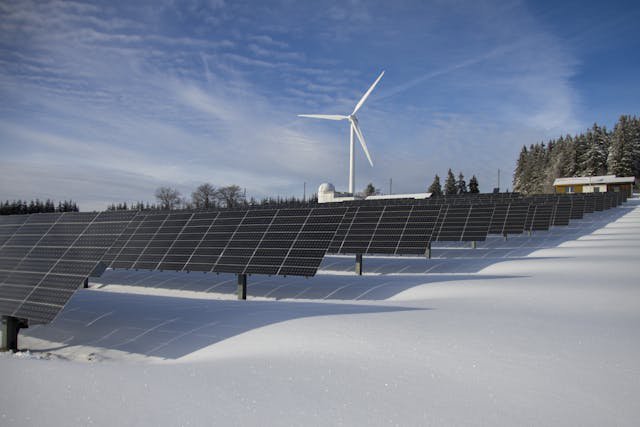
Photo by Pixabay
So you can get involved by:
a. Green Real Estate Development/ Urban Planning
As we saw earlier in the projects section, governments are investing heavily in green infrastructure, and specializing in this may prove to be very useful. The ability to implement energy efficiency, renewable energy, and eco-friendly design helps lower the carbon footprint of infrastructure.
b. Environmental Consulting
Eco-consultants are necessary to advise developers and governments on the environmental impacts of projects and find ways to reduce the negative environmental impacts of infrastructure development.
c. Renewable Energy and Building Systems
Perhaps the most important aspect of sustainable infrastructure is constantly evolving technology and ideas. Building techniques have evolved over decades, and have not made it easy to incorporate sustainable technology additions into them. Significant changes take time, yet they are necessary in constructing buildings with low emission costs. Motivated minds that can advise on strategies to make this process more efficient are always in demand.
5. Sustainability in Data, Finance, and Economics
Sustainable finance refers to financial activities that take into account environmental, social, and governance factors as a means of promoting sustainable economic growth. The main focus of sustainable finance is investing and funding green initiatives and considering environmental impacts when making financial decisions. This is often referred to as green finance.

Photo by Lukas Blazek
So how can you start on this:
a. Sustainability/ESG analysts
They use data to analyze the environmental impact of a business or project. As firms shift towards more sustainable projects, analysts have become more in demand and can determine how sustainable a project is.
b. Green Loans
Banks are understanding the importance of the wave of sustainable projects; they provide loans for electric vehicles and clean energy projects. Having a banker who understands the intricacies of how sustainability factors into the projects will prove to be useful both to the bank and to the environment.
c. Government and Policy Roles
Money and financing are a major part of any meaningful sustainability project or campaign, but the government plays an even larger role, as we discussed earlier. Most advanced economies place sustainability as one of their highest priorities, and policy making enables you to implement sustainability through various channels like carbon pricing, taxation, economic plans that assist environmentally and socially, and climate policy changes. All of these decisions require a good understanding of data and making data-driven decisions to favour sustainability efforts.
Sustainability Certificates and Courses at the University of Alberta
There are a number of ways to get started. The University of Alberta provides a range of certificates and courses from Political Science, Media Studies, Finance, Fashion, and everything in between — U of A has got you covered!
Aside from these non-sustainability-related courses, the University of Alberta also provides certifications and courses related to sustainability itself.
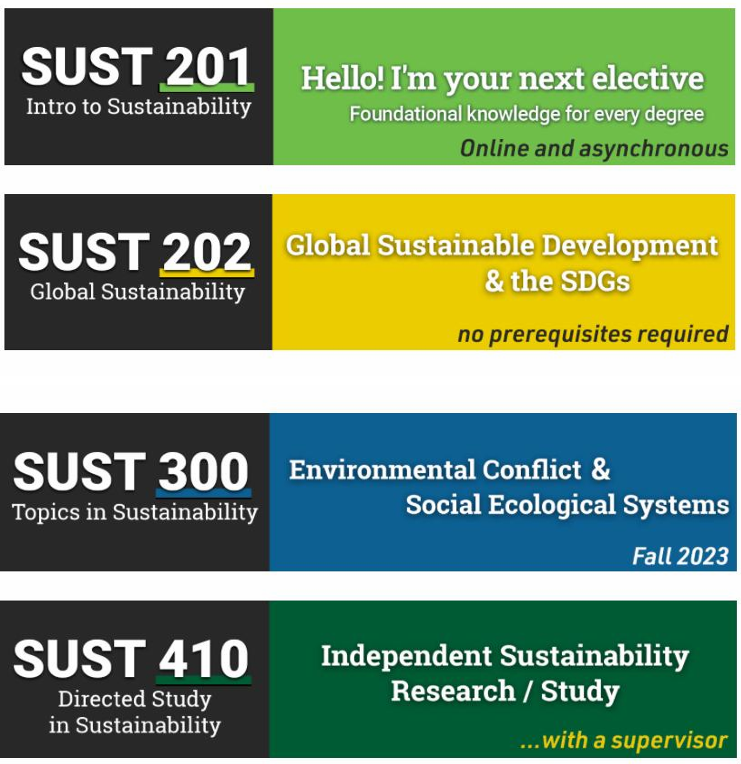
These courses are an introductory way to expand your knowledge about the environment and how to sustain it.
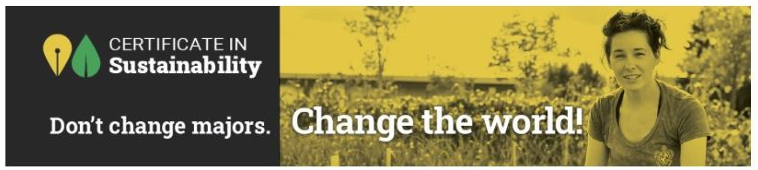
Additionally, the University of Alberta also offers a certificate in sustainability, a program that doesn’t require switching majors, but focuses on teaching about human and ecological issues. In this way, students can blend sustainability into their existing degree, further equipping students with the necessary skills needed to join this industry.
The world is progressing to bring about a positive impact through innovative employment opportunities and meaningful projects. Regardless of the different majors students pursue, both the University of Alberta and other educational platforms provide valuable certificates to raise awareness and improve one’s knowledge of sustainability.
There is no such thing as a second planet, so let us sustain this one!
Written by Darshita Guckhool and Jerchel Angelique Calucag
Edited by Navdeep Badhan and Raeghan Cromwell
References
United Nations. (n.d.). Sustainability | United Nations. https://www.un.org/en/academic-impact/sustainability
The 3 pillars of sustainability: environmental, social, and economic. (n.d.). https://www.enel.com/learning-hub/sustainable-development/three-pillars-sustainability
What is Economic Sustainability? (2024, May 16). Greenly. https://greenly.earth/en-gb/blog/ecology-news/what-is-economic-sustainability
Fischhoff, M. (2025, November 4). What is social sustainability? Network for Business Sustainability (NBS). https://nbs.net/what-is-social-sustainability/
Nbs. (2025, November 4). Environmental Sustainability – Meaning, Examples and importance. Network for Business Sustainability (NBS). https://nbs.net/environmental-sustainability-meaning-examples-importance/
Planetary boundaries. (n.d.). Stockholm Resilience Centre. https://www.stockholmresilience.org/research/planetary-boundaries.html
Canada, G. A. (2024, February 28). Canada announces support for new green hydrogen project in Newfoundland and Labrador. Canada.ca. https://www.canada.ca/en/global-affairs/news/2024/02/canada-announces-support-for-new-green-hydrogen-project-in-newfoundland-and-labrador.html
Housing, I. a. C. C. (2024, October 4). Housing, Infrastructure and Communities Canada - Natural Infrastructure Fund. https://housing-infrastructure.canada.ca/nif-fin/index-eng.html
Secretariat, T. B. O. C. (2025, September 16). Greening Government Strategy: A Government of Canada Directive. Canada.ca. https://www.canada.ca/en/treasury-board-secretariat/services/innovation/greening-government/strategy.html
Government of Canada, Statistics Canada. (2025, May 27). Employment in the environmental and clean technology products sector by demographic characteristics. https://www150.statcan.gc.ca/t1/tbl1/en/tv.action?pid=3610069101
Wilson, A. (2025, August 13). What is sustainable fashion? ECO Canada. https://eco.ca/blog/what-is-sustainable-fashion/
Eco, G. G. (2024, September 5). The Environmental Impact of Traditional vs Sustainable Fabrics. greatergoodeco.com. https://greatergoodeco.com/environmental-impact-raditional-vs-sustainable-fabrics
International Institute for Sustainable Development (n.d.). What is sustainable infrastructure? Sustainable Asset Valuation (SAVi) FAQ. https://www.iisd.org/savi/faq/what-is-sustainable-infrastructure-2
Sustainable infrastructure. (n.d.). https://www.gihub.org/sustainable-infrastructure/
“Careers in the Environment, Climate Change.” (24 May 2019) Undergraduate Programs. uwaterloo.ca/future-students/missing-manual/careers/careers-environment-sustainability-and-climate-change
“Explore Environmental Career Profiles.” ECO Canada, eco.ca/career-profiles-index/
Green Career Centre. “The Future of Green Jobs: Non-Traditional Roles in Sustainability and Social Impact - Green Career Centre.” Green Career Centre, 12 June 2025, www.greencareer.ca/whats-new/the-future-of-green-jobs-non-traditional-roles-in-sustainability-and-social-impact/%0A
Atwood, Kassie. “ESG Legal Issues and Why It’s Important to In-house Lawyers.” Thomson Reuters Law Blog, 11 June 2025, legal.thomsonreuters.com/blog/why-esg-is-important-to-in-house-lawyers-part-1
“Sustainability for Business: ESG Fundamentals.” Coursera, 2 Dec. 2024, www.coursera.org/learn/esg
“The Sustainable Development Goals – a Global, Transdisciplinary Vision for the Future.” Coursera, 14 Sept. 2020, www.coursera.org/learn/global-sustainable-development
“Introduction to Sustainability.” Coursera, 24 Sept. 2020, www.coursera.org/learn/sustainability