

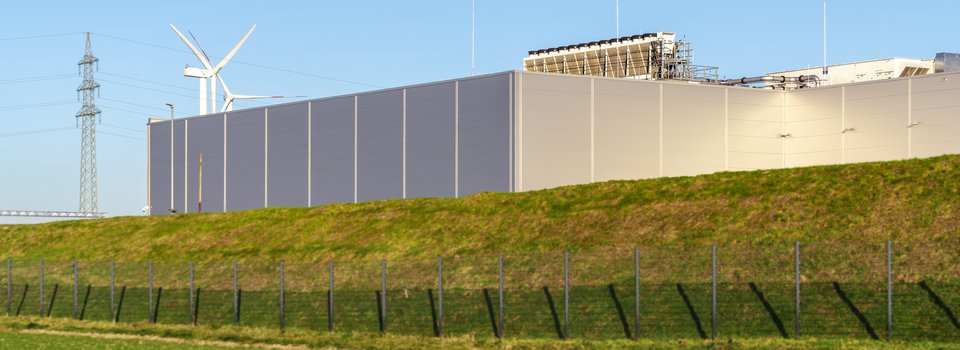
AI is often described in two very different ways. Some see it as a powerful tool that could help address climate change and improve energy systems. Others see it as an environmental problem in itself, pointing to the growing electricity demand of data centers and large AI models.
The reality is more complex. AI has a measurable environmental footprint, but it is also being used in ways that could support sustainability. Understanding both sides is essential when evaluating how this technology will shape the future.

Source: Unsplash/İsmail Enes Ayhan
The Hidden Energy Cost of AI
Most people interact with artificial intelligence every day without ever seeing the infrastructure behind it. Every chatbot response, recommendation system, or AI generated image relies on large data centers filled with thousands of processors running continuously.
Training large AI models can require substantial electricity. For example, training the GPT-3 language model has been estimated to consume around 1,287 megawatt-hours (MWh) of electricity, producing hundreds of tons of carbon emissions depending on the energy source used (Patterson et al., 2021).
Even after training is completed, energy consumption continues. Everyday AI interactions, known as inference, occur millions of times each day through search engines, digital assistants, and recommendation systems. While a single query uses only a small amount of electricity, the combined demand becomes significant when scaled globally.
At a larger scale, the infrastructure powering these systems already consumes significant electricity. Data centers worldwide used about 415 terawatt-hours (TWh) of electricity in 2024, representing roughly 1.5% of global electricity consumption (International Energy Agency, 2025).
These concerns do not necessarily mean AI is inherently unsustainable. The environmental impact of AI systems depends heavily on factors such as data center efficiency, hardware design, and the energy sources powering those systems.
Where AI Is Helping Sustainability
Despite the environmental cost of computing infrastructure, artificial intelligence is also being used to support sustainability efforts in several areas.
Climate Modeling and Environmental Monitoring
AI systems are increasingly used to analyze large climate datasets and improve environmental predictions. Machine learning models can process satellite imagery, weather records, and climate simulations to detect patterns that would be difficult to analyze manually.
These tools support improved forecasting of extreme weather events such as floods, heatwaves, and wildfires. Earlier and more accurate predictions can help governments and communities prepare more effectively and reduce damage from natural disasters.

Source: NASA/Hubble Space Telescope
Smarter Energy Systems
Artificial intelligence is also being integrated into modern electricity systems. Smart grid technologies use machine learning to analyze large amounts of energy data and help balance electricity supply and demand.
AI systems can forecast electricity demand, predict renewable energy production, and optimize how energy is distributed across the grid. These tools help utilities integrate renewable sources such as solar and wind, which fluctuate depending on weather conditions.
Researchers note that AI can improve efficiency and decision-making in energy systems by processing complex data from electricity networks and renewable energy sources (Alsaigh et al., 2022).
By improving efficiency across electricity networks, AI systems may help reduce energy waste and support the transition toward cleaner energy systems.
Agriculture and Resource Efficiency
Artificial intelligence is also being used in agriculture to improve efficiency while reducing environmental impact. Precision agriculture systems analyze soil conditions, crop health, and weather patterns to determine when irrigation or fertilizer is needed.
By providing farmers with better data and predictions, these systems can help reduce water consumption, detect crop diseases earlier, and optimize harvest planning. Improved efficiency can reduce food waste while also minimizing the environmental impact of excessive fertilizer or pesticide use.

Source: Unsplash/thisisengineering
When AI Makes Sustainability Harder
Although AI can support environmental goals, it can also contribute to sustainability challenges when deployed without considering its energy costs.
The rapid expansion of large-scale machine learning systems has increased demand for computing resources, leading to higher electricity consumption in data centers and potentially greater carbon emissions in regions that rely heavily on fossil fuels.
Experts note that the environmental impact of AI depends largely on how it is implemented. While AI may increase energy demand, it could also help reduce emissions by improving efficiency in sectors such as energy, transportation, and agriculture (International Energy Agency, 2025).
This creates an important trade-off. Some AI applications, such as climate prediction or energy optimization, may deliver significant environmental benefits, while others may consume energy without producing meaningful societal value.
Ethical and Social Risks of AI
Beyond energy consumption, AI also raises ethical and governance challenges. Experts warn that AI systems can reflect biases present in the data used to train them, which may lead to inaccurate predictions or policies that disadvantage vulnerable communities. Concerns also exist around transparency, since many advanced AI models operate as complex “black boxes,” making it difficult to understand how decisions are made. In addition, privacy risks and unequal access to computing infrastructure could widen the global digital divide, limiting the ability of developing countries to benefit from AI-driven climate solutions (UNFCCC, 2025).
Why This Matters for Students
For students studying technology, engineering, or environmental science, artificial intelligence represents both an opportunity and a responsibility.
The environmental impact of AI will depend largely on how it is developed and deployed. Designing more efficient algorithms, improving data center sustainability, and prioritizing applications that support environmental goals could help ensure that AI becomes part of the solution rather than part of the problem.
AI will likely play a major role in shaping future technologies. Whether it ultimately supports sustainability or contributes to environmental strain will depend on the choices researchers, engineers, and policymakers make today.
Written by: Roshan Banisetti
Edited by: Navdeep Badhan and Raeghan Cromwell
References
Patterson, D., Gonzalez, J., Le, Q., et al. (2021). Carbon Emissions and Large Neural Network Training.
https://arxiv.org/abs/2104.10350
International Energy Agency. (2025). Energy and AI.
https://www.iea.org/reports/energy-and-ai
Alsaigh, R., Mehmood, R., & Katib, I. (2022). AI Explainability and Governance in Smart Energy Systems: A Review.
https://arxiv.org/abs/2211.00069
United Nations Framework Convention on Climate Change. (2023). AI and Climate Action Report.
https://unfccc.int/ttclear/misc_/StaticFiles/gnwoerk_static/tn_meetings/0ec396b0ba7b4d0d853b77c7b83dc172/3ebbf2e8e7834a7f873b0ae9a86262f7.pdf
United Nations Framework Convention on Climate Change (UNFCCC). (2025).
AI and Climate Action: Opportunities, Risks and Challenges for Developing Countries.
https://unfccc.int/news/ai-and-climate-action-opportunities-risks-and-challenges-for-developing-countries